2026 rental selection: confirm the load, site and charging first
Updated . RS Mech’s confirmed rental ranges are diesel 1.5T–23T and electric 1.5T–5T. These are nominal machine classes, not a promise that every unit is available or can lift its rated tonnage in your configuration. Start with the diesel forklift rental and electric forklift rental pages to compare the categories, then confirm the selected unit for your job.
- Load: share the verified weight, dimensions, centre of gravity, lift height and any attachment. Ask for residual capacity at that height and load centre on the actual machine’s load chart. A long or irregular load can need a different class from a compact pallet of the same weight.
- Site: describe enclosed and outdoor work zones, ventilation, floor condition and loading, slopes, aisle width, turning space and doorway or overhead clearance. Include delivery access and any contractor or terminal entry conditions. Fuel type alone does not make a forklift suitable for rough ground.
- Electric charging: confirm the battery and compatible charger, the site’s electrical supply and connection, a suitable charging location and the hours available between shifts. Give actual operating hours and breaks so runtime and charging can be checked for the supplied unit. Do not assume a battery will cover a full shift or that every lithium-ion unit supports the same fast-charge schedule.
- Diesel operation: agree fuel supply and refuelling arrangements. For enclosed or semi-enclosed work, have the site safety team assess exhaust exposure and ventilation before choosing diesel. Electric avoids engine exhaust at the point of use, but still needs charging and workplace risk controls.
Request a written quote with the dates, working hours, selected model and capacity, battery and charger if electric, attachments, delivery and collection, fuel or electricity responsibilities, servicing scope and any applicable charges. Share operator-training and site-document requirements too. LM certification is available on request; confirm the document, arrangements and site acceptance for the selected unit before delivery.
If both categories look suitable, ask for like-for-like quotes using the same load, hours and hire period. Compare the total agreed scope, not just the headline rental charge. For narrow aisles and high racking, also check whether a reach truck rental for warehouse work is a better fit.
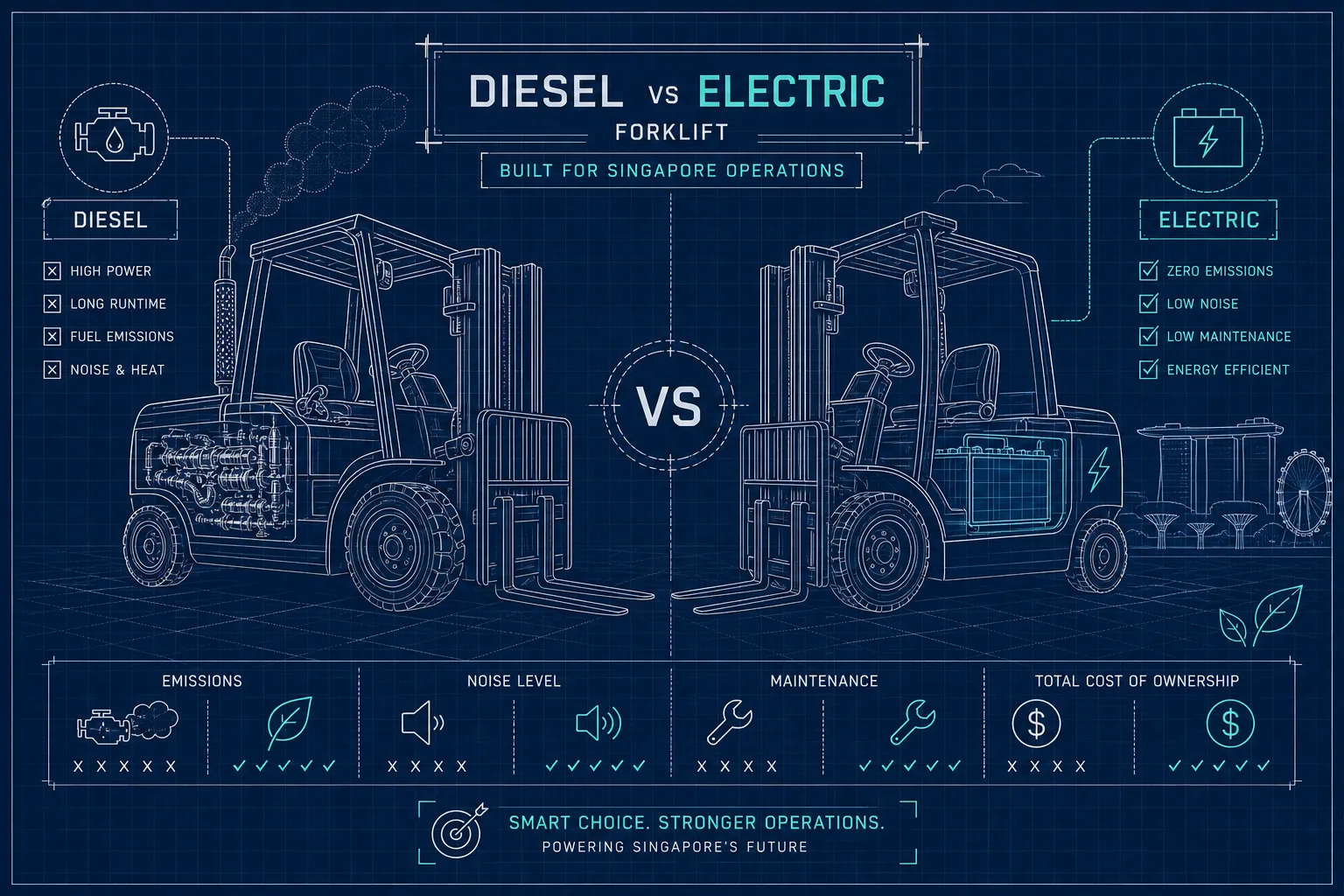
Diesel and electric forklifts suit different jobs. The sections below explain the main checks, but the actual machine, load chart and site assessment decide what is suitable. Do those checks before comparing the rental cost.
Check the operating environment
Diesel forklifts produce engine exhaust and noise. Enclosed and semi-enclosed work needs an assessment of exhaust exposure and ventilation. Electric forklifts avoid engine exhaust at the point of use and can suit indoor work, but the battery, charging area, traffic routes and other workplace hazards still need controls.
Indoor warehouse vs outdoor construction site: the core split
Electric is a useful starting point for enclosed warehouses, food-handling areas and fulfilment centres because it avoids engine exhaust. Confirm suitability for cold stores or other special environments with the supplier. Diesel is often considered for open yards, construction and heavier outdoor work. Neither choice removes the need to check the ground, access, load and working hours for the particular machine.
Mixed-use sites and dual-fleet thinking
A site may have covered storage, a semi-enclosed loading bay and an open yard. Assess each zone and the routes between them. Separate machines can be useful if one cannot meet every requirement, but do not assume a mixed fleet is always cheaper or necessary.
Marine, shipyard and port operations: a special case
Marine and shipyard environments introduce a third category that does not fit cleanly into the indoor/outdoor split. Covered ship halls and semi-enclosed fabrication bays share characteristics with indoor warehouses — diesel exhaust accumulates — but the loads, surfaces, and duty cycles match outdoor heavy-duty work. Check outdoor and covered work separately; do not assume air quality is acceptable just because a bay is partly open. For a rental enquiry with RS Mech, specify the load weight, load centre, ground conditions and ventilation so the team can assess the appropriate unit and site requirements.
Singapore WSH Rules on Indoor Diesel Operation
SS 573:2012 is the Code of practice for the safe use of powered counterbalanced forklifts. It covers manufacture, application, operation and maintenance safety, and parties’ responsibilities; it is not a ventilation-only standard. The WSH Council’s forklift guidelines recommend ventilation to prevent gases and vapours accumulating. Use a site-specific risk assessment and suitable controls for both diesel and electric work.
Operator training and refresher requirements
MOM requires WSQ Operate Forklift training. Operators of forklifts above 5 tonnes must also attend Heavy Forklift training. Operators must be competent and familiar with the machine; employers should check training records and experience before authorising work. The WSH Council also recognises operators who completed the former MOM-accredited Forklift Driver’s Training Course.
- Initial training: Check the operator’s WSQ Operate Forklift training or recognised former training records, competence and familiarity with the selected machine.
- Upcoming refresher requirement: From 1 January 2027, MOM requires Forklift Operator Refresher Training at least once every three years after initial training or the previous refresher. As at 10/11/2026, this is upcoming; it is not a universal three-year certificate-expiry claim.
- Above 5 tonnes: MOM requires additional Heavy Forklift training for operators of forklifts above 5 tonnes. Do not describe that separate course as WSQ-certified or MOM-approved.
- Site-level requirements: Managed construction sites and industrial terminals (including Jurong Island) often require operators to register with the main contractor's safety management system, in addition to the required training and competence.
- Rental implications: Whether arranging an employee or a contracted operator, confirm the required training, experience and machine familiarity before delivery. Share any additional contractor requirements when requesting a quote.
See MOM’s training and refresher guidance and the forklift regulations Singapore guide for the wider equipment and site checks.
Compare the costs in the written rental scope
There is no guaranteed cost winner. The hire period, operating hours, machine specification, energy use and agreed support affect the result. For a rental decision, compare quotes for the same job. If you are also considering ownership, get current machine, servicing and battery quotes rather than treating a generic five-year estimate as a promise.
Like-for-like comparison checklist
This table assumes the same verified load, working hours and rental dates for both options. It lists items to confirm, not rental rates, service-interval promises or guaranteed savings.
| Factor | Diesel | Electric |
|---|---|---|
| Rental specification | Capacity, mast and attachments | Capacity, mast, attachments, battery and charger |
| Energy responsibility | Fuel supply and refuelling | Electrical supply and charging |
| Site preparation | Exhaust controls and refuelling area | Charging area and compatible power connection |
| Servicing | Manufacturer schedule and agreed coverage | Manufacturer schedule, battery care and agreed coverage |
| Support and exclusions | Fault reporting, repair scope and applicable charges | Battery/charger support, repair scope and applicable charges |
Battery check: service life and replacement cost depend on the actual pack and use. Ask about battery condition, expected runtime for your shift and the agreed support if it cannot meet the planned work. No universal five-, seven- or ten-year battery life is promised here.
Plan the charger and shift schedule before delivery
Confirm the supplied battery, charger and electrical connection before booking. Check where the forklift will charge and who is responsible for battery care. The planned charging windows must fit the work, rather than relying on a headline runtime or fast-charge figure.
Charging time and duty cycles
Lead-Acid
Charge time: Confirm the supplied battery and charger
Cool-down: Follow the manufacturer’s cooling guidance
Check overnight charging time, battery-care duties and any swap arrangement for additional shifts.
Lithium-Ion
Charge time: Confirm charger output and available power
Cool-down: Follow the manufacturer’s temperature limits
Opportunity charging is an option only where the actual battery/charger supports it and the shift provides enough breaks.
For multiple shifts, give the supplier your operating hours, load intensity and breaks. Confirm whether the supplied battery can cover that pattern, whether opportunity charging or a battery swap is supported, and what space and handling arrangements are needed. A lithium-ion label alone does not establish continuous-shift runtime. Have the site check the electrical supply and charging-area risks before delivery.
Capacity, power and duty cycles: matching tonnage to task
Fuel type and lifting capacity are separate decisions. Do not choose a machine class from the name of the job or load weight alone. The table lists information to supply; it does not recommend tonnage or confirm stock.
| Application | Load information | Machine/site check |
|---|---|---|
| Warehouse pallets | Weight, pallet dimensions and lift height | Residual capacity, aisle width and floor loading |
| Factory-floor materials | Dimensions, centre of gravity and handling frequency | Attachments, turning space and indoor exhaust controls |
| Construction materials | Verified weight and proposed handling method | Ground, access and actual load chart |
| Precast concrete panels | Verified weight, dimensions, centre of gravity and lifting arrangement | Approved attachment and residual capacity; assess suspended-load requirements separately |
| Steel coils or machinery | Weight, shape, support points and centre of gravity | Suitable attachment, load chart and travel route |
| Port or container work | Verified cargo details and approved handling method | Specialist equipment suitability and terminal conditions |
Check heavy-capacity work against the actual unit
Diesel is often considered for heavier outdoor work, but the handling arrangement and load chart determine whether the machine is suitable. RS Mech's diesel rental fleet runs from 1.5T up to 23T, with a heavy-duty rental range of 7T–23T. Our electric rental range is 1.5T–5T. Confirm capacity at the actual load centre, attachments and unit availability before selecting a machine; larger industry classes are not confirmation of our rental stock.
Check tyres, ground condition, slopes and the loaded travel route for the proposed unit. A counterbalance forklift is not automatically suitable for rough terrain because it runs on diesel. Confirm the duty cycle and refuelling or charging plan for the actual working hours. For panels or other suspended loads, refer to the regulations guide and the supplier’s approved arrangement rather than slinging a load from ordinary forks.
LTA registration and what it means for your rental
LTA requires engineering plants to be registered before they are used or driven on public roads. Registration alone does not mean a particular unit is permitted on the road. Confirm the selected unit’s road-use permission and conditions before planning any road movement. For private-site work, establish the intended use and check any applicable conditions with the provider or LTA.
LTA’s registration process includes vehicle approval and registration inspection. Confirm any ongoing inspection requirements for the specific unit; do not assume every forklift follows one annual LTA schedule. LM certification is available on request. Share the exact document, attachment, intended use and site-acceptance requirements so arrangements can be confirmed; it is not blanket approval for every operation.
Check the project’s written equipment requirements
BCA Green Mark 2021 is a building certification scheme. A Green Mark label alone does not establish a universal electric-forklift requirement. Ask the contractor for any written low-emission or electric-equipment specification before requesting a quote.
Electric forklifts avoid engine exhaust at the point of use, but they are not compliance-free. Operator training, risk assessment, load limits, inspection and charging controls still matter. Keep training and equipment records available for the site safety team, and refer specific legal or insurance questions to the relevant authority or advisers.
Your pre-rental checklist: five questions before you commit
Most procurement mistakes happen before the forklift arrives on site. Run through these five questions before you sign a rental agreement.
- 1
Is the area enclosed, semi-enclosed, or open?
Assess each zone, exhaust exposure, ventilation and the route between zones. Electric avoids engine exhaust, not all workplace hazards.
- 2
What is your shift pattern?
Confirm runtime, the actual charger and available charging windows. Additional shifts may need opportunity charging or a suitable swap arrangement, depending on the supplied unit.
- 3
Has the operator’s training and machine familiarity been checked?
Check required training and competence, including Heavy Forklift training above 5 tonnes. Plan for the three-year refresher requirement effective 1 January 2027.
- 4
Does the unit need to access Jurong Island or a managed construction site?
Share entry-pass, delivery and contractor document requirements. Confirm access and site acceptance before booking.
- 5
What is your commitment horizon?
Request a written quote for your actual dates and working hours. Compare hire periods, delivery/collection, energy responsibilities and servicing scope; no duration guarantees a saving.
Rent both types first, then commit
RS Mech rents diesel forklifts from 1.5T to 23T and electric forklifts from 1.5T to 5T, with flexible daily, weekly, and monthly rental terms, subject to availability. Trial both under real operating conditions before signing a long-term contract or committing capital to a purchase.
Frequently asked questions
Do I need a licence to operate a forklift in Singapore?
MOM requires WSQ Operate Forklift training and Heavy Forklift training for operators of forklifts above 5 tonnes. Operators must be competent and familiar with the specific machine. The WSH Council also recognises operators who completed the former MOM-accredited Forklift Driver’s Training Course. Check training records before authorising work; do not assume one certificate covers every machine.
When does mandatory forklift refresher training start?
MOM’s three-year refresher requirement takes effect on 1 January 2027. Operators must attend Forklift Operator Refresher Training at least once every three years after their initial course or previous refresher. As at 10/11/2026, this is an upcoming requirement, not a statement that every forklift certificate already expires after three years.
Can I use a diesel forklift in a warehouse in Singapore?
Assess exhaust exposure and ventilation with your site safety team before using diesel equipment in an enclosed or semi-enclosed area. The WSH Council recommends ventilation to prevent gases and vapours accumulating. SS 573:2012 is the Code of practice for the safe use of powered counterbalanced forklifts, not a ventilation-only standard. Electric forklifts avoid engine exhaust at the point of use, but charging and other workplace hazards still need controls.
How long does a forklift battery last in Singapore's climate?
There is no battery lifespan that applies to every forklift. Battery chemistry, condition, duty cycle, temperature and charging practices affect usable capacity and service life. For a rental, ask about the supplied battery’s condition, expected runtime for your shift, compatible charger and support arrangements. Follow the manufacturer’s charging guidance rather than relying on a guaranteed number of years.
What is the right forklift tonnage for precast concrete panels?
Panel weight alone cannot determine the forklift class. Provide the verified weight, dimensions, centre of gravity, lift height and proposed handling arrangement. Confirm residual capacity on the actual machine’s load chart with any approved attachment fitted. Suspended-load work has additional requirements; do not select a nominal tonnage or sling panels from ordinary forks on the strength of this comparison guide.
What is the difference between LTA registration and operator training?
LTA registration concerns the equipment and its intended public-road use. Operator training concerns the person operating it. Engineering plants must be registered before public-road use, but registration alone does not mean the selected unit is allowed on the road. Confirm the unit’s road-use permission, applicable inspections and site conditions separately from the operator’s training and competence.
Does RS Mech supply forklifts to Jurong Island?
Discuss Jurong Island or Tuas delivery with RS Mech when requesting a quote. Jurong Island entry passes and site-specific equipment requirements need advance coordination. Confirm the selected unit, access arrangements, availability and delivery timing before booking; this guide does not promise a fixed access lead time.
Making the call
Start with the verified load, lift height and travel route. Electric can suit enclosed work where avoiding engine exhaust matters; diesel is often considered for heavier outdoor jobs. Confirm the actual machine’s residual capacity, floor and access requirements before deciding. Mixed sites may need separate equipment or work zones.
Check operator training and competence for either type. Prepare for the mandatory three-year refresher requirement from 1 January 2027, and confirm any project-specific equipment rules. SS 573 addresses safe powered counterbalanced-forklift use broadly; it does not make electric operation exempt from workplace safety checks.
Use the diesel and electric rental category pages above as the next step, then send RS Mech the load, site, shift pattern and dates for a written quote. If considering a trial rental, confirm suitability and availability first; a trial must not bypass the load-chart or site-safety checks.