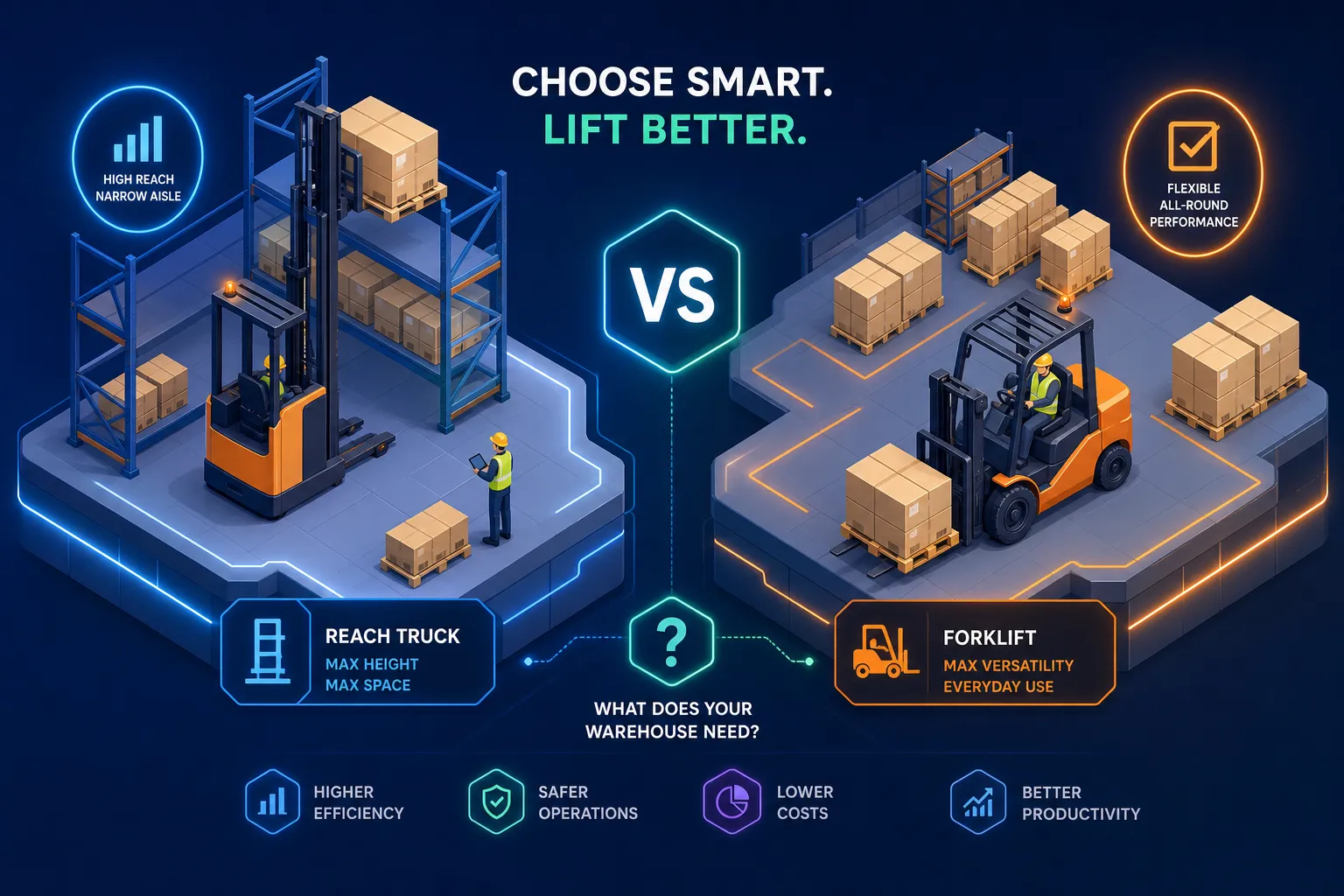
What each machine is actually built to do
A reach truck is an electric, indoor-only machine with extending forks that reach forward into racking without the entire truck having to drive into the bay. Outrigger legs at the front distribute the load and keep the unit stable at height. This design makes reach trucks purpose-built for narrow-aisle warehousing, high-racking configurations, and dense storage layouts where every square metre counts. In Singapore, you will find them working in 3PL facilities, e-commerce fulfilment centres, and cold chain storage operations where rack density and height demand it.
A counterbalance forklift is what most people picture when they hear the word "forklift": a heavy rear counterweight balances whatever load sits on the forks. Available in both diesel and electric variants, counterbalance units are built for wider aisles, heavier or irregular loads, mixed indoor-outdoor use, and loading dock operations. Manufacturing plants, construction sites, port operations, and cross-dock facilities in Singapore rely on them precisely because of that versatility.
Neither machine is universally superior. The right call depends entirely on your warehouse's physical layout and how your operators actually move through a shift.
Aisle width and racking height: the two fastest filters
Aisle width is the fastest filter when choosing between a reach truck and a forklift in a Singapore warehouse. Standard reach trucks need a minimum working aisle of roughly 2.7 to 2.9 metres, with a recommended working width closer to 3 to 3.2 metres for comfortable operation with varied load sizes. Counterbalance forklifts typically require a minimum of about 3.7 metres, with 3.4 to 4 metres being the practical wide-aisle design range.
Industry benchmarks suggest storage gains of up to 50% are achievable in ideal narrow-aisle configurations; a conservative real-world estimate for a straightforward reach truck conversion sits closer to 20 to 30% additional bays, depending on your existing layout. For a 10,000 sq ft Singapore warehouse, even the lower end of that range translates directly into additional revenue-generating pallet positions.
Lift height is often where the decision becomes definitive. Electric reach trucks commonly handle lift heights of 9 to 13.7 metres. Counterbalance forklifts in standard warehouse configuration typically top out at 3 to 6 metres. Singapore 3PL facilities commonly rack to 8 to 10 metres, while e-commerce fulfilment centres run between 5 and 7 metres. If your racking clears the 6-metre mark, a reach truck is almost always the right answer.
| Factor | Reach Truck | Counterbalance Forklift |
|---|---|---|
| Min. aisle width | 2.7–2.9 m | 3.4–3.7 m |
| Max. lift height | 9–13.7 m | 3–6 m (standard) |
| Typical load capacity | 1,360–2,040 kg | 1.5T–25T+ |
| Indoor use | ✅ Designed for | ✅ Yes |
| Outdoor / dock use | ❌ Not suitable | ✅ Yes |
| Energy type | Electric only | Diesel or Electric |
| Energy cost (SGD/hr) | ~S$1–2 | ~S$5–8 (diesel) |
| Monthly rental (SGD) | ~S$750–1,500 | ~S$600–3,000+ |
Load profile, floor conditions, and where reach trucks fall short
Reach trucks are optimised for standard palletised loads in the 1,360 to 2,040 kg range. Counterbalance forklifts span a far wider capacity band, from 1.5T all the way to 25T and above for heavy port and terminal applications in Singapore. If your operation handles irregular, oversized, or very heavy loads, the rear counterweight configuration handles the stress more predictably, and the wider fork spread accommodates non-standard pallet geometry better.
Outdoor dock warning
If your operators need to move between an indoor racking area and an outdoor dock within the same shift, you need a counterbalance forklift at minimum. A Singapore warehouse with an exposed loading dock that gets wet during the afternoon rain creates conditions a reach truck cannot safely handle.
Floor conditions are equally decisive. Reach trucks require smooth, level, dry indoor surfaces. MOM's WSH guidance reinforces this directly: employers must account for floor loading capacity, braking distance, and surface condition when planning any lift truck operation.
Cost comparison: rental and running costs in Singapore
New reach trucks in Singapore run roughly S$34,000 to S$50,000 depending on brand, lift height, and specification; used units in good condition come in around S$25,000. Monthly rental rates vary — expect a range of roughly S$750 to S$1,500 per month, with short-term or single-unit arrangements sitting toward the higher end.
Running costs tell a different story over time. Electric reach trucks cost roughly S$1.00 to S$2.00 per operating hour in energy at Singapore's commercial electricity tariff; diesel counterbalance forklifts run closer to S$5 to S$8 per hour in fuel alone at the current diesel pump price, before factoring in oil changes, filters, and exhaust servicing. For a warehouse running two shifts, the combined energy and maintenance savings from a reach truck can be substantial over the equipment's life.
Safety, training, and WSH compliance in Singapore
Both reach truck and forklift operators in Singapore must complete a WSQ Operate Forklift course from a WSQ-accredited provider. Reach truck courses cover theory, practical assessment, pre-use inspection, stacking and retrieval, and emergency procedures.
Employer obligations under the WSH Act go beyond ensuring the operator holds a certificate. You must formally authorise each operator before they touch either machine and document a safe system of work. Beyond that: carry out risk assessments, designate clear operating zones, ensure adequate lighting, and specify appropriate PPE. Operators must be at least 18 years old, medically fit, and able to follow English-language operating instructions.
5-question decision checklist
Run through these five questions against your actual warehouse layout before you commit to either machine.
1Are your aisles 3 metres or narrower?
2Does your racking go above 6 metres?
3Do operators move between indoor storage and an outdoor yard in the same shift?
4Are your loads over 2,000 kg or irregularly shaped?
5Is reducing energy cost and emissions a priority?
Making the call
The reach truck vs forklift decision comes down to three physical realities: aisle width, racking height, and floor or outdoor conditions. Cost and compliance layer on top of those, but they rarely override the physical constraints. The key thresholds are straightforward — aisles under 3 metres and racking above 6 metres point strongly to a reach truck; outdoor use, heavy or irregular loads, and wide-aisle layouts point to a counterbalance forklift.
Many Singapore warehouses run both machine types in different operational zones, and that is a perfectly sensible arrangement. A reach truck handles dense indoor high-bay storage while a counterbalance forklift manages the loading dock and yard. Getting the zoning right matters more than picking a single machine to do everything.
Use the checklist above as your starting point, then get a rental quote on your shortlisted machine before signing anything long-term. A two-week pilot on the right equipment will tell you more than any specification sheet, and it costs far less than 12 months on the wrong one.